2025 West Best Projects
Project of the Year, Best Water/Environment: Klamath River Renewal Project
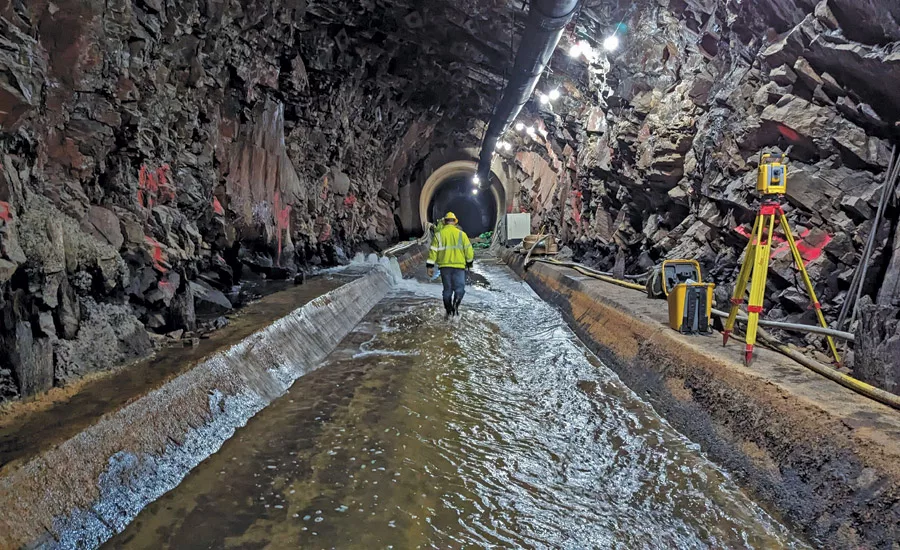
Careful coordination and planning allowed the project to be completed in just 16 months.
Klamath River Renewal Project
Calif.
BEST PROJECT, WATER/ENVIRONMENT
Submitted by Kiewit Infrastructure West Co.
Key Players
Owner Klamath River Renewal Corp.
Lead Design Firm Knight Piesold
General Contractor Kiewit Infrastructure West Co.
The Klamath River Renewal project involved the removal of several dams in Northern California (and southern Oregon) over the span of just 16 months. In October 2024, the project was completed on budget and ahead of schedule, returning 35 river miles to natural habitat for the first time in over a century. Kiewit Infrastructure West Co., working for project owner Klamath River Renewal Corp. (KRRC), handled the demolition of 100,000 cu yd of concrete, 1.3 million cu yd of earth and 2,000 tons of steel in the removal of four dams—each unique—built between 1903 and 1962.
“The work finished ahead of schedule and on budget,” says Dan Petersen, Kiewit project manager, “achieving a milestone that tribes, communities and federal, state and local stakeholders had pursued for decades. The project also involved multiple high-risk operations that required disciplined planning and execution to be carried out safely.”

Demolishing the dams required removing 100,000 cu yd of concrete and 1.3 million cu yd of earth.
Photo courtesy Kiewit
The largest dam removal effort in U.S. history—and possibly the world—opened more than 400 miles of river for salmon passage. Kiewit served as the general contractor operating under a guaranteed maximum price, and owner KRRC managed water levels to not only draw down reservoirs to naturally clear sediment but also to ensure the safety and effective demolition of four dams. The project was completed with a zero incident rate and zero lost-time accident rate.
The combined heights of the JC Boyle (the only of the four dams located in Oregon), Copco No. 1, Copco No. 2 and Iron Gate dams reached 425 ft with a total generation capacity of 163 megawatts. The 50-year license owned by PacifiCorp to operate the dams expired in 2006, and a 10-year negotiation with federal, state and local governments along with two tribal nations and nine conservative and fishing groups resulted in an agreement to transfer the licenses to KRRC to manage the decommissioning and dismantling of four hydroelectric facilities, a $450-million project paid for by PacifiCorp customer surcharges and Proposition 1 water bond funds.
Kiewit structured water levels in 2023 to remove the smallest of the four dams—42-ft-tall Copco No. 2—in fall 2023, removing the other three together throughout 2024.
Throughout it all, standard approaches wouldn’t have been enough. Petersen says that at Copco No. 1, modular bridges gave crews safe access and separation from the powerhouses. Flexifloat barges supported dredging at the tunnel entrance and controlled reservoir drawdowns that allowed the river to move built-up sediment. The team used specialty winching equipment connected to an excavator to handle demolition. Establishing onsite housing gave the workforce an advantage in such a remote location by keeping collaboration strong and response times fast.
Petersen says the biggest challenge required moving more than 1 million cu yd of embankment at Iron Gate while keeping downstream areas safe. Copco No. 1 demanded drilling a 10-ft tunnel through 100 ft of concrete reinforced with railroad steel, then executing a one-time tunnel blast to drain the reservoir. At Copco No. 2, crews timed reservoir cycling so the dam could be dismantled completely in the dry. “All of this had to be done with narrow windows tied to salmon migration,” Petersen says.

Reopening the river for the first time in over a century, the project converted 35 river miles to natural habitat.
Photo courtesy Kiewit
Detailed preconstruction planning and constant coordination across sites was key, Petersen says. The project was organized into smaller, independent sites that reported back to a centralized hub office. Daily check-ins with the hub and remaining aligned with the overall program allowed each site to stay focused on its section while still moving the larger effort forward. Working on four different dams under the same umbrella was a lesson in teamwork, Petersen says, especially with around 140 craftworkers and staff all working in a remote location away from family.
Copco No. 1 was a 144-ft-tall, narrow concrete arch dam. Kiewit employed a combination of blasting and mechanical hoe ramming for demolition. “The big thing with that was the timing aspect and being able to minimize impact to fish,” Petersen says. “We wanted one season of impact. From the time we got going, we did the blasting and that allowed us to dislodge and haul as quickly as possible.”
The trickiest challenge at the 1918-built Copco No. 1 was drilling a 10-ft-dia tunnel through the base of the 100-ft-thick concrete base to allow for the water drawdown, all while leaving a 10-ft-long plug at the end of the tunnel to release when it came time to send water through the dam. The team also created modular bridges on site—two 60-ft-long bridges each rated for 100 tons—that allowed them to separate themselves from the powerhouse 200 ft downstream and the water flows. “Once we got the bridges on, we could turn the powerhouse on and give us a full season worth of work to get the tunnel in and make the schedule,” Petersen says. “It was a bit of a challenge, but a great solution.”
“The post-dam removal recovery of the landscape has been nothing short of amazing.”
—Mark Bransom, CEO, Klamath River Renewal Corp.
The 175-ft-tall Iron Gate required millions of yards of excavation on a fully earthen embankment dam with a clay core. Just on that dam, Kiewit had 17 haul trucks ranging from 772s to 773s to 775s and some of the largest excavators on the project. At peak, the total project featured about 30 excavators, the largest from the 395 family.
Crews had to carefully watch the pace of removal to ensure the dam could still handle a 100-year event, especially as work progressed earlier and quicker at JC Boyle and Copco No. 1. “There was a pretty sophisticated water management and planning effort to accommodate the removal of the three remaining dams,” says Mark Bransom, CEO at KRRC.
The KRRC now transitions to maintenance and monitoring. The corporation will remain in existence through 2028 or 2029, depending on how the restoration meets conditions of the various permits. At that point the corporation will dissolve, and all project lands will transfer to the states or a third-party designee of the states.
Since dam removal, the site has blossomed. “The post-dam removal recovery of the landscape has been nothing short of amazing,” Bransom says. “From the return of adult salmon within days of the completion of dam removal in October 2024, to the restoration of native vegetation we’re planting, the landscape is really beautiful to observe. Water quality has improved, and the river is showing a more natural temperature regime as the tributaries contribute cold, clean water to the Klamath River instead of flowing into the warm reservoirs.”