What We Know About the Scaffold System at Wang Fuk Court
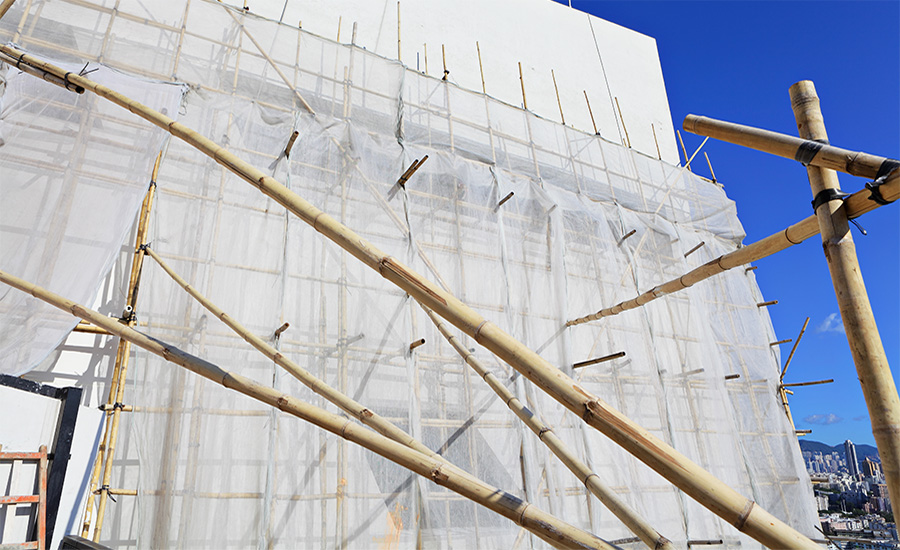
Traditional bamboo scaffolding wrapped in protective mesh surrounds a high-rise undergoing façade renovation in Hong Kong. Investigators say similar scaffold assemblies at Wang Fuk Court are central to understanding how flames climbed the exterior during the city’s deadliest residential fire in decades. Photo by leungchopan/Adobe.
The exterior-wall renovation underway at the Wang Fuk Court estate relied on a full-perimeter bamboo scaffold assembly, a traditional tied-lashed system widely used in Hong Kong for high-rise maintenance. All eight towers had been enclosed in bamboo frames wrapped in green polyethylene netting for several months as part of a large-scale façade repair program overseen by the estate’s owners’ corporation.
According to early statements from the Hong Kong Fire Services Department, crews arriving minutes after the first alarm found the scaffolding on one block already heavily involved, with flames traveling rapidly across the netting and into window openings. Security Secretary Chris Tang said investigators believe a combination of combustible scaffold components, wind conditions and the multi-tower enclosure allowed flames to climb quickly up the façade.
Authorities are testing whether the scaffold netting, waterproof sheets and other temporary coverings installed on the towers met required fire-retardant standards. Samples collected by the Buildings Department and the Independent Checking Unit of the Hong Kong Housing Bureau have been sent for laboratory analysis. Police have also highlighted polyurethane foam installed around elevator-lobby windows as a material being examined for potential noncompliance.
Prestige Construction & Engineering Co. Ltd., the contractor for the renovation, erected the scaffold with scaffolding subcontractors. Following the fire, the Hong Kong Buildings Department inspected 11 other projects involving the contractor to determine whether similar scaffold configurations or temporary materials were in use. Officials said further action will depend on test results and compliance reviews now underway.
Regulators subsequently ordered all registered professionals and contractors to reconfirm the fire-retardant certification of scaffold nets, tarpaulins and related temporary materials on active façade projects. The declarations will be followed by targeted field audits and independent verification of product testing records. Early evidence released by Hong Kong authorities indicates the scaffold enclosure played a central role in the fire’s rapid vertical spread.
Scaffold Assembly Illustration
The illustration below depicts a traditional bamboo scaffolding arrangement similar to systems commonly used in Hong Kong for exterior-wall renovation. Investigators say the scaffolding and protective coverings at Wang Fuk Court are central to understanding how flames traveled vertically during the Nov. 26 fire.

Illustration: Traditional bamboo scaffolding structure similar to those used in Hong Kong high-rise renovation work. Such assemblies are now under scrutiny as investigators examine how flames climbed the façade during the Wang Fuk Court fire. Graphic generated by AI / Engineering News-Record ©2025.